

UCO School of Engineering Senior Design Presentations
 Jory Blaney
Senior students from the University of Central Oklahoma School of Engineering showcased their work and presentations in the Liberal Arts building on Dec 2 and 4.
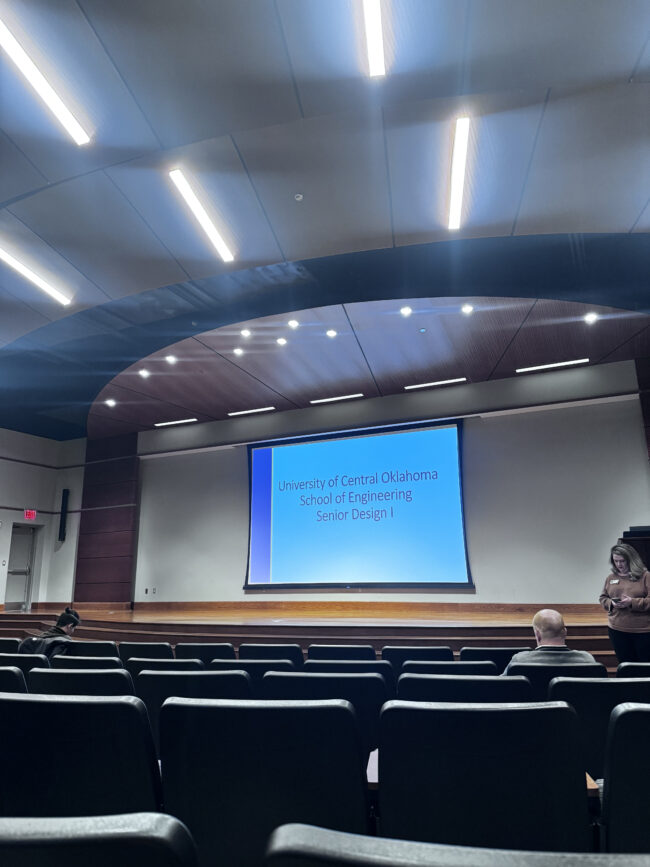
“We are very excited to showcase our senior designs today,” said Dr. Alsbou, the Senior Design Instructor at UCO, in her welcoming remarks.
The Senior Design I Presentations began with seven groups of two or three people sharing their work and explaining what they had been working on throughout the semester, as well as what they hoped to improve upon going into the next semester.
One recurring theme among the groups was that their designs for the mechanism were lower in cost than current designs. The groups shared that they were working with a school-issued budget and that it was more cost-effective than the current designs used by the public.
Team 1 was comprised of Abraham Ross, Cole Woodard, and Colton Miller. Team 1 shared first with their low-cost pulley system to make the Czochralski method more available to universities. They said that their mechanism, designed for crystal growth and purification, was made for UCO Howell Hall and that if it succeeded, it could potentially be available to other universities in the future.
Team 2, formed by Lorelei Potter, Brett Bailey, and Les Malan, showed their automated line-of-sight antenna alignment system. They discussed how the Federal Aviation Administration uses the LOS antennas and how the alignment over time due to environmental factors will drift.
They claimed the realignment process is labor-intensive and requires multiple engineers. Their mechanism they talked about showed that the system could take in data for its alignment and tell the engineers how far off it is. They discussed how this algorithm could be used to lower labor and other direct costs for the government.
Team 3, with Raj Zala and Michael Jones, showed their ejection mechanism for the APSX-PIM (Automatic Plastic Injection Molding Machine). It is a machine used for creating plastic injection molding. They said that the lack of automatic ejection increases cycle time, which limits its effectiveness.
“The current ejection method adds unnecessary time in an educational setting,” said Michael Jones.
For day 2, there were only 6 teams compared to the 7 teams that were presented on day 1. Much like day 1 of presentations, each group showed unique engineering designs compared to the other groups.
Senior Design II Team 1 of Trey Grisham, Mason Teeter, and Trevor Morris went first with their Orbit Storage System. They described their goal as to eliminate the need for heavy lifting or using ladders for overhead storage.
They claimed that this could minimize the risk of injuries and maximize space efficiency. According to this team, current storage systems have a high risk of injury and are not very accessible.
Team 2 of Bright Lena, Barbie Bridges, and Henry Lee went next with their wind tunnel for 3D printed object testing. The current problem they described is that there are issues with the aerodynamics and heat transfer with the current testing equipment.
They claimed their final goal is to create a user-friendly wind tunnel lab space for UCO faculty and students to use and benefit from for years to come.
Team 3 of Malaak Akour, Thi Nguyen, and Nicole Schulz displayed their reconfigurable hand control unit. They said the current problem is that thousands of planes get retired and go to sit in aircraft boneyards. Their solution is to reuse and recycle some of the components of these aircraft on a smaller scale for desktop interaction.
These students have worked hard on these projects, and the Fall Senior Design presentations were their chance to showcase all the work they have put in.